
Table of Contents
- Why Statement Fashion Matters for Creative Professionals
- Understanding Creative Professional Attire
- How to Style Statement Pieces Without Losing Professionalism
- Business Casual Outfits for Creatives
- Building a Capsule Wardrobe for Creative Professionals
- Dressing for Your Creative Industry and Workplace Culture
- Balancing Personal Style with Professional Expectations
- Frequently Asked Questions
Last Updated: October 11, 2026
Why Statement Fashion Matters for Creative Professionals
Your clothes tell a story before you speak a word. For creative professionals, statement fashion for creative professionals isn't just about looking good, it's about claiming space in your industry and showing the world who you are.
Creative work demands authenticity. Your personal style signals confidence, creativity, and a willingness to break the mould, this is where statement pieces come in.
Your wardrobe should reflect your vision while keeping you credible in client meetings and collaborative spaces. The balance between self-expression and professionalism is a skill.
Get it right, and your wardrobe becomes a tool that amplifies your creative identity.
Understanding Creative Professional Attire
Creative professional attire allows personality while maintaining respect. Unlike corporate dress codes, creative workplaces expect you to bring yourself to the table, but bold doesn't mean careless.
The sweet spot is business casual that leans creative. This means:
- Tailored basics as your foundation (structured trousers, fitted blazers, clean shirts)
- Statement pieces that command attention (graphic tees, bold prints, colourful blouses)
- Accessories that finish the look (statement jewellery, unique bags, interesting shoes)
- Intention in every choice (nothing random, nothing sloppy)
Your creative professional attire should feel curated, not costumey. The difference between "too casual" and "creative casual" comes down to fit and finish: a boxy oversized tee with tailored dark trousers reads professional; the same tee with gym leggings reads sloppy.
How to Style Statement Pieces Without Losing Professionalism
The biggest mistake creatives make is treating statement pieces like they exist in isolation. They don't. A statement piece only works when it's balanced by restraint everywhere else.
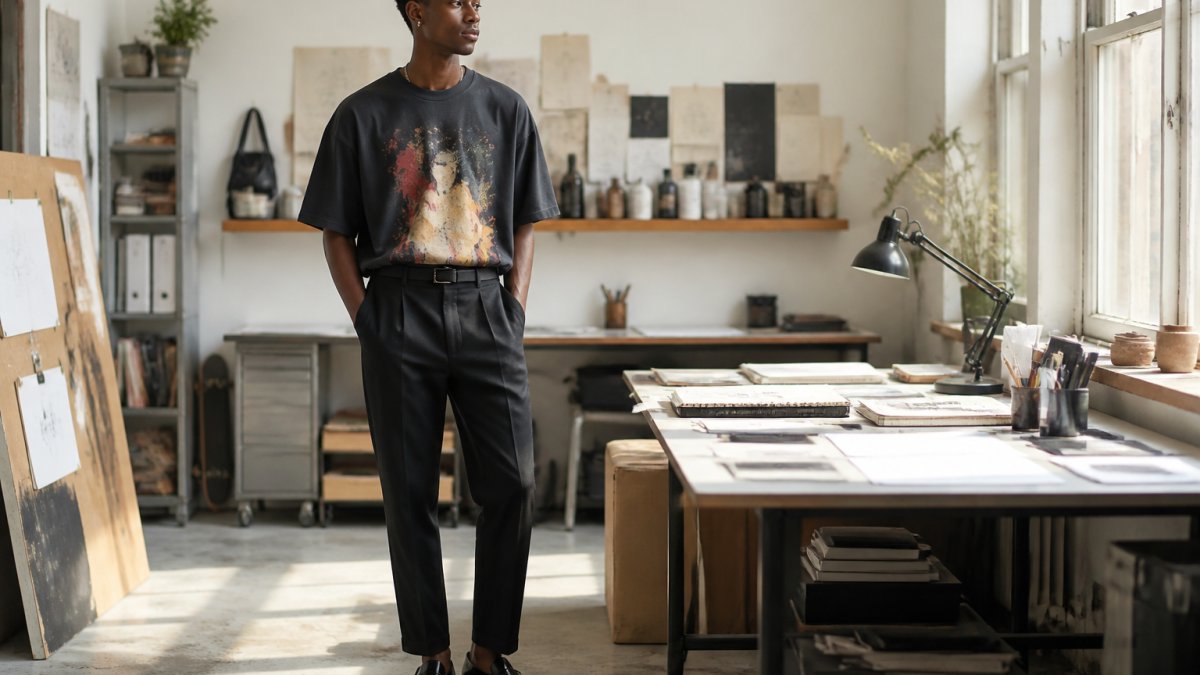
Think of your outfit as a visual hierarchy. One element should dominate. Everything else should support it without competing.
Pairing Bold Prints with Tailored Basics
Bold prints demand calm companions. The formula: bold print top + neutral bottoms + neutral shoes + minimal jewellery. Tailored basics are your anchor, they transform a statement piece into workwear. Dark trousers create a professional base; a structured blazer adds authority.
The MAI - Written in The Stars tee (£24.99) works because heavyweight 240 gsm cotton and boxy oversized fit give it presence. Pair with tailored dark trousers and leather loafers for a creative, credible look. When wearing a bold print, dial everything else down: skip patterned jewellery, choose a simple structured bag, and let the print be the story.

Using Colour and Pattern Strategically
Colour and pattern require skill. One bold colour paired with neutral bottoms reads confident; two bold colours competing reads chaotic. One patterned piece per outfit is the rule. The boldest looks succeed through restraint: choose one element to shine and build everything else around it.
Adapting Statement Styling to Your Body, Budget, and Practical Needs
The formula above works in theory, but real creative professionals face different constraints. Your approach to statement pieces should account for your body type, budget, commute, and accessibility needs.
For different body types: Statement pieces don't have to be oversized. Choose what fits you confidently, fitted or loose, but ensure the fabric has weight so it reads intentional rather than shapeless.
For different budgets: Invest where it shows: the statement piece, one quality blazer, and one pair of well-fitting dark trousers. Basic tees and neutral layers can be affordable. Rotate statement pieces seasonally for more outfit variety.
For commuting and climate: Choose wrinkle-resistant fabrics. Layer strategically: a statement tee under a blazer stays pristine during commute.
For hybrid and remote work: Wear bolder statement pieces on office days; on remote days, wear comfortable basics. This keeps statement pieces fresh and intentional.
For accessibility: Choose fabrics that feel good on your skin. Ensure your statement piece doesn't restrict movement and that basics support how you move.
Business Casual Outfits for Creatives
Business casual for creatives means showing up as a professional who happens to have taste. Start with: dark tailored trousers, a crisp button-up or fitted tee, a structured blazer, and clean shoes. Add one statement element: a bold patterned blouse, colourful knit, statement jewellery, unique bag, or shoes with interesting details. This works in client meetings and hybrid environments.
Building a Capsule Wardrobe for Creative Professionals
A capsule wardrobe is a collection of pieces that work together. For creatives, it's essential because you're building a visual identity.
Core Pieces Every Creative Needs
Your foundation should include: two or three tailored trousers, two fitted blazers, four basic tees, two button-up shirts, one pencil skirt, minimal trainers or loafers, one structured bag, and one cardigan. These pieces are your vocabulary, neutral enough to work with statement pieces but structured enough to read professional alone.
Statement Pieces That Anchor Your Outfits
Add statement pieces strategically: two or three bold graphic tees, one colourful blouse, one patterned piece, and accessories with personality. Each statement piece should work with multiple foundation pieces. This builds a wardrobe that feels infinite even when small.
Dressing for Your Creative Industry and Workplace Culture
Statement fashion for creative professionals looks different depending on workplace culture and the stakes of being misread.
Assess your workplace: What do senior creatives wear? Who do you interact with most? What happens if you get it wrong? Understanding these helps you calibrate your statement pieces to your context.
Design and Digital Studios
Design and digital studios embrace visual expression. Wear bold graphic tees and statement trainers, your peers expect you to take risks. But intention matters: a carefully chosen oversized tee reads differently from a random band tee. Studio culture rewards taste, not just boldness.
Client-Facing Creative Roles
Client-facing work requires a different calculation. Signal creativity without creating doubt. A statement piece paired with impeccable tailored basics works; a bold outfit that feels unfinished doesn't. Ask: Does this make me look more creative or more risky? Bold colour or interesting pattern with professional tailoring reads creative. Unconventional cut or heavy distressing reads risky.
Practical outfit examples:
- Colourful blouse (jewel tones, interesting print) + dark tailored trousers + structured blazer + simple leather shoes + minimal jewellery
- High-quality graphic tee (heavyweight cotton, intentional design) + tailored dark trousers + structured blazer + leather loafers + one statement accessory (watch or bag)
- Neutral basics + one statement piece that's clearly professional (patterned silk scarf, bold but tailored jacket, interesting shoes with clean lines)
Risk-assessment checklist for client-facing days:
- Does this piece look intentional or accidental? (Intentional = professional; accidental = risky)
- Would I feel confident explaining why I chose this piece? (If yes, it's grounded; if no, it's a gamble)
- Does it pair with tailored basics that signal "I take this seriously"? (If no, skip it for client days)
- Is the fit impeccable? (Wrinkles, loose seams, or poor fit undermine credibility, even in creative spaces)
Advertising, Marketing, and Strategy Roles
These roles sit between studio and client-facing. You're creative but also strategic. Your dress code often mirrors your industry: if you work in fashion or lifestyle marketing, bolder is expected. If you work in finance or B2B marketing, more conservative is safer.
What works: A statement piece that shows you understand trends and aesthetics, but doesn't look like you're trying too hard. This might mean a bold colour in a classic silhouette, or a subtle pattern in a professional cut.
Practical outfit examples:
- Jewel-toned blouse + neutral trousers + minimal accessories
- Patterned shirt (small or medium scale) + solid trousers + structured blazer
- Neutral basics + one statement accessory that shows taste (interesting bag, bold jewellery, or shoes with character)
Hybrid and Remote Creative Work
Hybrid work creates freedom and requires strategy. You're not in the office every day, which means you can take more risks on in-office days while staying comfortable on remote days.
On remote days: Wear what makes you feel creative and comfortable. Your appearance doesn't affect how clients or colleagues perceive you. Use this freedom to experiment, to wear pieces that feel good but might be too bold for the office, or to prioritise comfort.
On office days: Lean slightly more professional than you would in a studio setting. You're signalling that you respect the shared space while still being authentically you. This is where your statement pieces shine, they're intentional choices for specific days, not everyday uniform.
Practical strategy: Build your capsule wardrobe with this split in mind. Invest in statement pieces that work with your office basics. On remote days, pair those same statement pieces with comfortable basics (soft trousers, relaxed layers). On office days, pair them with tailored basics. The same tee works both ways; the context changes.
Balancing Personal Style with Professional Expectations
The tension between personal style and professional expectations is real. But it's not a problem to solve, it's a creative constraint.
The best creative professionals don't choose between authenticity and professionalism. They use professionalism as a framework for authenticity. Your personal style becomes more powerful when it's expressed within intentional boundaries.
This means:
- Knowing your workplace culture and respecting it (even if you're pushing against it)
- Choosing statement pieces that reflect who you actually are, not who you think you should be
- Investing in quality basics so your statement pieces have a strong foundation
- Understanding that "professional" doesn't mean "boring", it means "considered"
Your wardrobe is a conversation between you and your workplace. The goal isn't to win the conversation. It's to have one where both sides feel heard.
When you dress intentionally, you signal that you take your work seriously. When your intentional choices reflect your actual style, you signal that you take yourself seriously. That combination is powerful.
Statement fashion for creative professionals works because it solves a real problem: how do you show up authentically in a professional space? The answer isn't to choose one or the other.
Start with the foundation. Pieces like those from M.Art.Inc, including the MAI - Written in The Stars and The Graveyard Shift, MAI Halloween Edition (both £24.99), are designed to anchor your outfits while letting your personality shine through.

Frequently Asked Questions
How do I style a statement piece for the office without looking unprofessional?
Pair your statement piece with neutral, tailored basics. An oversized graphic tee works best with slim-cut trousers, a structured blazer, or a simple skirt in dark colours. Keep accessories minimal and let the statement piece be the focal point. This approach works across creative workplaces because it signals confidence in your personal style while maintaining polish. Choose pieces made from quality fabrics like heavyweight cotton so they hold their shape through the workday.
What makes statement fashion different from just wearing bold colours?
Statement fashion is intentional self-expression through specific design choices, bold prints, artistic graphics, unexpected colour combinations, or thematic designs that communicate something about your creative identity. Bold colours alone are a starting point, but statement pieces tell a story. They show personality and artistic sensibility. For creative professionals, this distinction matters because it demonstrates that your style choices are deliberate and reflect your creative thinking, not accidental.
Can I wear statement fashion if I work in a client-facing creative role?
Yes, with strategy. Client-facing roles require you to balance self-expression with client expectations. Choose statement pieces that feel bold to you but read as polished to others, think artistic prints on quality fabrics rather than extreme designs. Pair them with tailored basics and professional accessories. Test the piece in lower-stakes client meetings first. Most creative clients actually respect authentic personal style; what matters is that your overall presentation looks intentional and professional.
How do I build a versatile capsule wardrobe that supports statement pieces?
Start with neutral tailored basics: dark trousers, simple button-ups, fitted blazers, and plain knitwear in black, grey, or navy. These anchor outfits and let your statement pieces shine. Add 3-4 statement pieces that work across seasons, graphic tees, patterned blouses, or thematic designs from collections you love. Choose pieces in complementary colour families so they mix and match. This approach means fewer total items but more outfit combinations, and every piece serves a purpose in expressing your creative identity.